 LB Electricals
What actually happens during an EICR
By Lewis Burton, city & guilds qualified ·
An Electrical Installation Condition Report is a health check on the fixed wiring of a property — the cables, sockets, switches, lights and the board they all run back to. It is not a look round. It is a structured inspection followed by a set of live and dead tests, and it ends in a report that either says the installation is satisfactory or says precisely why it isn't.
Most people meet an EICR for one of three reasons: they're a landlord and they're legally required to have one, they're buying or selling, or something has started behaving oddly and they want to know how bad it is.
The visual inspection
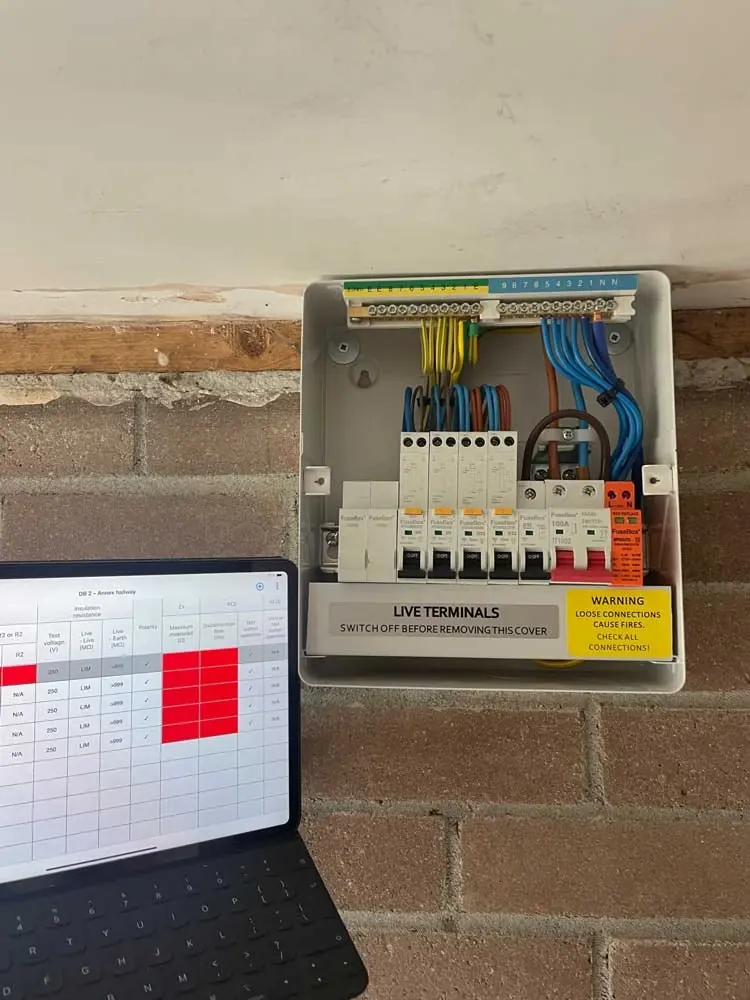
A surprising amount is found before a single test lead comes out of the case. The board is opened and inspected: is there RCD protection, is anything overheating, are the terminations tight, is the bonding to the gas and water services there and correctly sized, is there anything obviously bodged.
Then it's around the property — accessories, sockets, switches, light fittings, the bathroom, anything outdoors, the loft, under the floor where it's accessible. Damage, wear, DIY, scorching, cracked accessories, missing covers, cables run where they shouldn't be. Common finds in older stock: no RCD on the socket circuits, no bonding, junction boxes buried in the floor with no access, and an extension someone's added themselves.
The tests
The power goes off for the dead tests. Continuity of protective conductors — proving every earth actually gets back to the board. Insulation resistance — pushing a test voltage between the conductors to check the insulation hasn't broken down. Polarity — proving nothing has been wired the wrong way round, which is more common than you'd like.
Then the power goes back on for the live tests: earth fault loop impedance, which proves the protective device will actually operate fast enough if a fault occurs; RCD operating times, which proves the RCD trips inside its rated time; and prospective fault current at the origin.
Numbers, not opinions. That's the point of the exercise — an EICR that isn't backed by recorded test results on the schedules is not an EICR, it's someone's impression.
The codes, and what they actually mean
This is where people panic unnecessarily, so it's worth being precise.
- C1 — danger present. Risk of injury, right now. Anything C1 gets made safe on the spot, or the circuit is isolated before we leave. Exposed live parts, for example.
- C2 — potentially dangerous. Not dangerous today, but dangerous if a further fault or a bit of bad luck occurs. No earth at the lighting circuit is the classic one. C2 items must be put right.
- C3 — improvement recommended. Not dangerous, doesn't meet the current standard. It does NOT fail the report on its own, and you are not obliged to act on it. Plenty of C3s are simply the wiring regs having moved on since the house was built.
- FI — further investigation required. Something couldn't be resolved on the day and needs opening up or tracing. It fails the report until it's resolved.
'Unsatisfactory' is not a catastrophe
The report is marked unsatisfactory if there is anything coded C1, C2 or FI. That word does a lot of unnecessary emotional damage. An unsatisfactory report with one C2 on it — say, a missing earth at the light switches — is a specific, fixable job, not a condemned house.
What matters is what the codes say, not the word on the front page. A good report tells you exactly which circuit, exactly what's wrong, and what it takes to put it right. Then you can make a decision with numbers in front of you.
A word of warning worth having: an EICR is also the easiest document in the trade to abuse. If you're handed a report where half the installation is coded C2 with vague descriptions, and the same firm is quoting to fix it all, get a second opinion. The codes should be justifiable line by line.
How long, and what you need to do
A typical three-bedroom house takes roughly two to four hours depending on the number of circuits and how much of the property is accessible. Power will be off in stages.
You can help enormously by clearing access to the consumer unit, the loft hatch, and any sockets hidden behind furniture — an inspection can only report on what it can actually reach, and anything inaccessible has to be recorded as a limitation on the report.
If you need one on a property in Doncaster or Sheffield, call Lewis on 07467 381272 and we'll talk through what's involved.
Frequently asked questions
How often should a home have an EICR?
The standard recommendation for an owner-occupied domestic property is at least every ten years, or on change of occupancy. Rented properties in England are on a five-year cycle and that one is a legal requirement, not a recommendation.
Does a C3 mean I've failed?
No. C3 is 'improvement recommended' and does not make a report unsatisfactory. Only C1, C2 and FI items do. You can leave C3 items alone if you choose to — though they're often worth doing when something else is being worked on anyway.
Will you fix the faults you find?
Anything C1 is made safe there and then, because it's dangerous. Everything else is quoted separately so you can see what it costs before you decide — and you're free to take the report to anyone you like.
Do you need to turn the power off?
Yes, in stages, for the dead tests. Let us know before we start if there's anything in the house that mustn't lose power — medical equipment, a freezer, a home office on a deadline — and we'll work around it as far as the testing allows.