 LB Electricals
Why does my RCD keep tripping?
By Lewis Burton, city & guilds qualified ·
An RCD is the wide switch in your fuse box that trips the whole side of the board and takes half the house out with it. It is not being awkward. It is doing the one job it exists to do: it watches the current flowing out on the live and back on the neutral, and if more than about 30 milliamps goes missing somewhere — through faulty insulation, through damp, or through a person — it cuts the power in well under a tenth of a second.
So a tripping RCD is a message. The job is reading it correctly. Sometimes it means one appliance is on its way out. Sometimes it means water has got somewhere it shouldn't. Occasionally it means the wiring itself is tired. Here's how to tell them apart.
First, find out which circuit is at fault
You can do most of this yourself in about ten minutes, and it will save you money whoever you call.
If the RCD resets and immediately trips again with nothing plugged in and every breaker off, stop there and phone an electrician — that points at a fault in the fixed wiring rather than in something you own.
- Unplug everything on the affected side of the house — kettle, washer, dryer, chargers, extension leads, the lot.
- Switch off every small breaker (MCB) next to the tripped RCD.
- Reset the RCD. It should stay up.
- Switch the small breakers back on one at a time, waiting a few seconds between each. The one that drops the RCD is your problem circuit.
- Now plug the appliances on that circuit back in one at a time. If the RCD holds until the tumble dryer goes in, you've found it.
The usual suspects, roughly in order
A single faulty appliance is by far the most common cause. Anything with a heating element and a hard life is a candidate: kettles, tumble dryers, washing machines, immersion heaters, old fridges, hair straighteners. Their element insulation degrades and starts leaking current to earth. Very often it only leaks once the element is hot, which is why the trip happens twenty minutes into a wash cycle rather than the moment you switch it on.
Water is the next one. Rain driving into an outside socket, a leaking roof over a light fitting, a shower pull-cord in a steamy bathroom, water finding a buried cable after someone put a nail through it. Outdoor circuits that only trip when it rains are telling you something quite specific.
Then there's cumulative earth leakage. Every appliance leaks a tiny amount of current to earth quite legitimately — TVs, computers, LED drivers, induction hobs, boilers, EV chargers. Individually they're nothing. But if a single 30 mA RCD is covering half the house, add enough of them together and you can sit at 20-something milliamps all day long. Nothing is faulty; the RCD is simply close to its limit, so the smallest extra nudge tips it over. That's the classic 'it trips for no reason, usually in the evening when everything's on' fault, and it's a design problem, not a broken appliance.
Finally, borrowed or crossed neutrals. Older lighting circuits — particularly ones that have been extended by a previous owner, or where a two-way landing switch has been rewired badly — sometimes end up with the neutral of one circuit connected to another. Add an RCD to that and it trips the instant both circuits are used together. It is a common one in houses that have been part-rewired over the years.
Why a modern board trips less — and tells you more
An older board typically has one or two 30 mA RCDs, each protecting a whole bank of circuits. Nuisance-trip a board like that and you lose the lights, the sockets, the freezer and the alarm all at once, and you're left guessing which of thirty things caused it.
A board built with RCBOs gives each circuit its own combined overload and earth-leakage protection. A fault on the garden lights takes out the garden lights, and nothing else — the fridge stays cold, the router stays on, and you know instantly where to look. That's the practical argument for the change, and it matters more than the compliance one to most people living in the house.
It also removes the cumulative-leakage problem, because each circuit's leakage is now measured on its own instead of being added into a pile.
When it stops being a nuisance
Treat it as urgent, not annoying, if any of these are true: the RCD won't reset at all with everything switched off; there's a smell of burning or hot plastic near the board or a socket; there's scorching or melting anywhere; the trips started after water got in; or the board is warm to the touch.
In those cases leave the power off to the affected part of the house and call someone. An RCD that refuses to reset is usually not a faulty RCD — it is an RCD that has found something and is holding its ground.
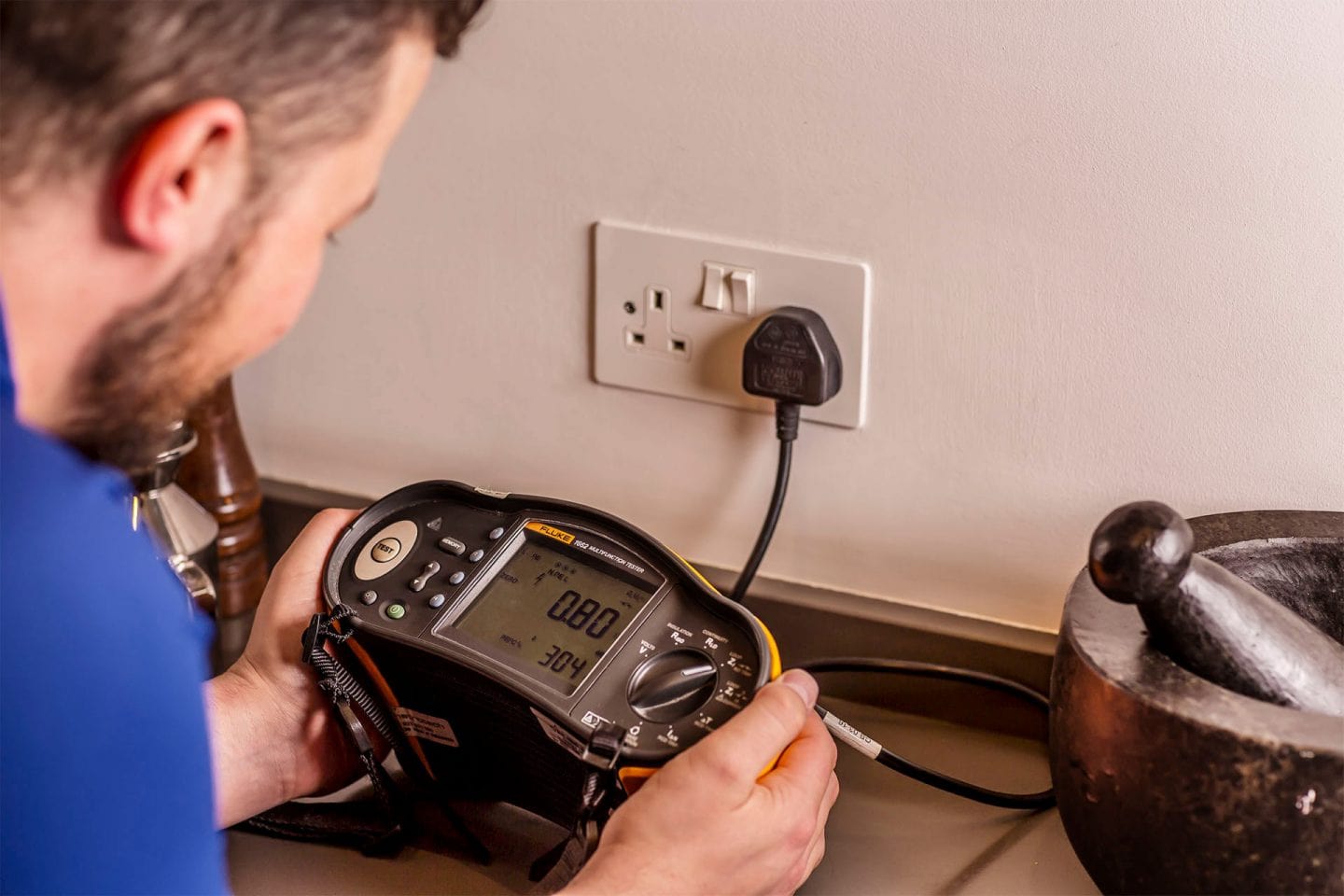
If you're in Doncaster or nearby and you'd rather someone just came and traced it properly with a test instrument instead of you playing switch roulette for a fortnight, call Lewis on 07467 381272.
Frequently asked questions
Is it safe to just keep resetting the RCD?
Resetting it once to see if it holds is reasonable. Resetting it repeatedly, several times a day, is not — you're overriding a safety device that has detected current going somewhere it shouldn't. If it keeps going, find out why.
Can a lightbulb blowing trip the RCD?
Yes, and it's very common. A filament or LED lamp failing can flash over as it dies and cause a brief fault that trips the protection. If the lights come back on after you reset it and replace the lamp, and it never happens again, that was almost certainly all it was.
My RCD trips but only when it rains. Why?
Water is getting into something outdoors — an external socket, a security light, a garden lighting joint, or a buried cable. Rain-only tripping is one of the easiest faults to narrow down and one of the most worth fixing, because outdoor circuits are exactly where earth leakage becomes dangerous.
Will replacing my fuse box stop the tripping?
It will stop nuisance tripping caused by cumulative leakage, and it will stop one fault taking out the whole house. It will not fix a genuine fault — if a cable or an appliance is leaking current, a new board will simply trip more precisely. Find the fault first; the board is a separate decision.