 LB Electricals
Consumer unit replacement: a plain-English guide
By Lewis Burton, city & guilds qualified ·
The consumer unit — the fuse box — is the one part of your electrical installation that everything else depends on. It is also the part most likely to be thirty or forty years older than the rest of the house.
Replacing it is a well-defined job with a fixed shape to it. What surprises most people is that the board itself is the easy bit. The work that decides whether the job goes smoothly happens before the new one ever comes out of the box.
When a board genuinely needs replacing
Not every old board is dangerous, and no honest electrician should tell you otherwise. But some are past arguing about.
- A wooden back board with rewireable fuses (the ceramic carriers with fuse wire in them) — no earth-leakage protection at all.
- A cast-iron or bakelite unit, or anything with no main switch you can find.
- No RCD protection on the socket circuits, the bathroom, or anything outdoors.
- Signs of heat: browning, scorching, a burnt-plastic smell, or a board that's warm to the touch.
- Circuits that trip in a bank, so a fault on one thing kills half the house.
- You're adding load the board can't take — an EV charger, an electric shower, a garden supply, a rewire.
The checks that have to come first
A new consumer unit is only as safe as the wiring it feeds, and modern protection is far more sensitive than a bit of fuse wire. Fit a new board onto tired old cable and the RCDs will find every fault in the house on day one — which is exactly what they're for, but not what you want to discover at four in the afternoon with the power off.
So the honest way to do this is to test the existing installation before quoting properly: insulation resistance on every circuit, earth continuity, the earthing and bonding arrangement, and the condition of the incoming supply. That tells you whether the house is ready for a new board or whether something needs putting right first.
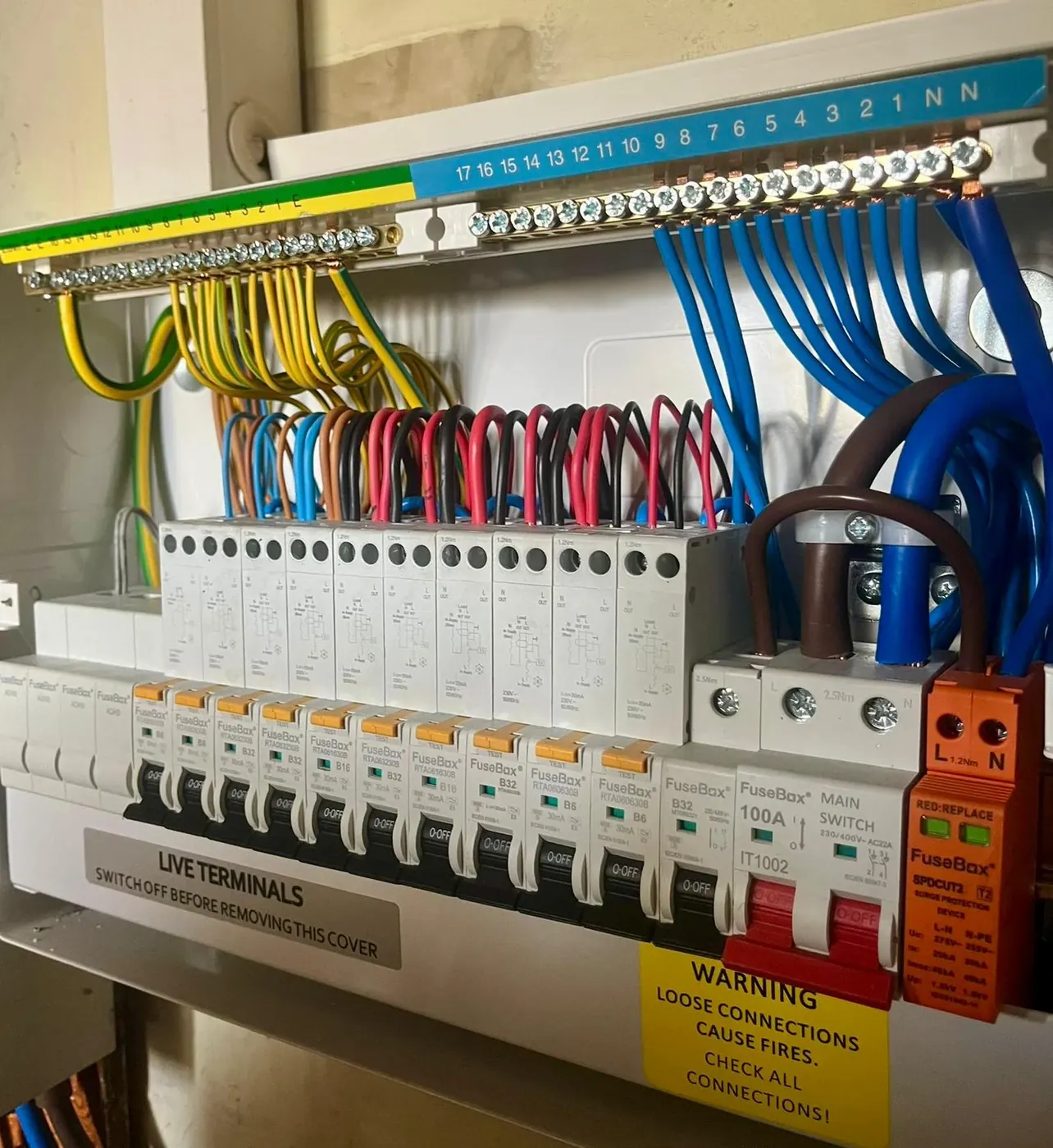
It also tells you whether your main earthing and bonding are adequate — the green-and-yellow conductors to the gas and water services. On a lot of older Doncaster properties these are undersized or simply absent, and they have to be sorted as part of the job. That's not an upsell; it's the thing that makes the new protection work.
What happens on the day
The power goes off for most of the working day, so plan around it: charge what needs charging, and don't start the day with a freezer full of food you can't afford to lose (it will be fine for a day if you leave the door shut, but it's worth knowing in advance).
The old board comes off, each circuit is identified and tested as it's disconnected, the new unit goes on, every circuit is re-terminated and labelled properly, and then the whole installation is tested and energised circuit by circuit. Labelling matters more than people think — a board where every way is clearly marked saves you and the next electrician a great deal of time.
Everything is tested and certified on completion, and you should be given the paperwork. Work carried out in line with applicable UK wiring regulations and good industry practice.
Surge protection, AFDDs, and what's actually worth paying for
Two things usually come up. Surge protection (an SPD) guards the house against voltage spikes — mainly from lightning striking the network, and from switching events on the supply. It matters more than it used to, because the things it protects are no longer just a kettle: it's the boiler PCB, the induction hob, the EV charger, the solar inverter and everything with a chip in it. It's a small module, fitted in the board, and it's usually worth it.
Arc fault detection (AFDD) is the newer one, and it detects the kind of arcing you get from a loose terminal or a damaged cable — the fault that starts fires but doesn't necessarily trip anything else. It costs meaningfully more per circuit. There are places it's genuinely recommended and places it's a nice-to-have; you should get a straight answer about which yours is rather than a blanket yes.
Ask what's included and why. A board full of features you didn't need is money that would have been better spent on the remedial work the test results found.
One thing to ask before anyone starts
Replacing a consumer unit is notifiable work under Part P of the Building Regulations in England. That means the local authority has to know about it, either through the electrician's competent-person scheme or by a building-control notification.
This isn't paperwork for its own sake — it's what you'll be asked for when you sell the house. So before work starts, ask the electrician plainly: how will this job be notified, and what certificate will I be given at the end? Any competent contractor will have a clear answer.
Frequently asked questions
How long does a consumer unit replacement take?
For a typical domestic board with no complications, allow a full working day with the power off. If the pre-installation tests turn up circuits that need putting right first, that's extra — which is why the testing comes before the quote, not after.
Do I need a new fuse box if mine still works?
Working and safe aren't the same thing. A rewireable fuse board works perfectly well right up until someone touches a live conductor — it has no earth-leakage protection at all. If yours has fuse wire in it, it should be changed. If it's a reasonably modern board with RCD protection and no signs of heat damage, it probably shouldn't.
Will the whole house be off all day?
The main power will be off for most of the day, yes. It comes back on circuit by circuit as each one is tested and energised.
What if the tests find problems with my existing wiring?
You get told before anything is committed to, with the results in front of you and a straight explanation of what has to be fixed for the new board to work safely and what can wait. Nobody should be finding out mid-job.
Is a consumer unit replacement the same as a rewire?
No. A rewire replaces the cabling throughout the house; a consumer unit replacement changes only the board the cables terminate in. A new board on genuinely bad wiring is a poor investment — the testing is what tells you which job you actually need.