 LB Electricals
Signs your house needs rewiring
By Lewis Burton, city & guilds qualified ·
A rewire is one of the most disruptive and expensive things you can do to a house, so it deserves a straight answer rather than a sales pitch. Plenty of houses that get quoted for a rewire don't need one. And a few that badly need one have owners who've been told everything's fine.
Here's how to tell which you are, without guessing.
The signs that genuinely mean it
These are age-of-cable and condition-of-cable issues. They can't be patched around and they don't improve with time.
- Rubber-insulated cable — usually black, and it goes brittle and crumbles when you flex it. It was phased out in the 1960s. If it's still in the walls, it's well past its life.
- Lead-sheathed or fabric/cloth-covered cable. Same story, older still.
- No earth at the lighting circuits — very common in houses wired before the mid-1960s. It's why so many older homes have plastic light switches and nothing metal on the ceiling.
- Round-pin sockets, or any sign the house is still partly on the old rewireable-fuse, no-earth arrangement.
- Insulation resistance readings that come back low across multiple circuits on a test. This is the objective one — it means the insulation is breaking down throughout, not in one place.
- Cable that's been overheated, run through insulation, or chewed by rodents across a wide area.
The signs that don't, whatever you've been told
An old-looking fuse box is not a reason to rewire the house. It's a reason to change the fuse box, which is a fraction of the cost and a day's work. The two get conflated constantly, sometimes conveniently.
Not enough sockets is not a reason to rewire. That's a job for additional circuits or spurs, done properly.
One circuit that keeps tripping is a fault, and a fault gets traced and fixed. It doesn't condemn the other seven circuits.
Plaster cracking, a dated kitchen, or a house simply being old — none of these tell you anything about the state of the cable behind the wall. Testing does.
How you actually find out
Get an EICR. It's the only honest way to make this decision, and it costs a tiny fraction of a rewire. The insulation-resistance and continuity results across every circuit will tell you whether the cable is genuinely at the end of its life or whether you have two circuits with problems and six that are fine.
That report also gives you leverage. It's a document with numbers in it. If someone has quoted you for a full rewire and the report says the wiring is sound with three specific remedial items, you have your answer — and you can spend the difference on something you actually wanted.
What a rewire actually involves, so you can plan
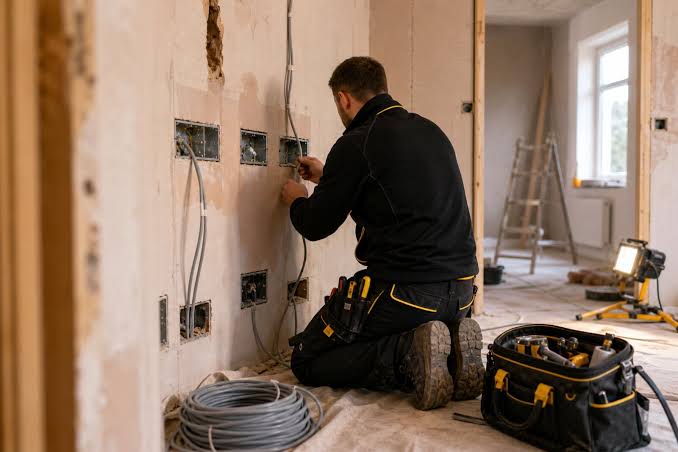
It's done in two halves. First fix: floorboards up, chases cut into walls, all the new cable run back to the board, back boxes in. The house looks considerably worse than when you started, and this is normal. Second fix: sockets, switches, lights and the new consumer unit all terminated, then the whole installation tested and energised.
Then there's making good — plastering the chases, floorboards down, decorating. That is real work and real money, and it needs to be in the conversation from the start rather than discovered afterwards. Ask any quote whether making good is included or excluded; the honest answer is usually 'chases filled, but you'll want a decorator'.
The best time to rewire a house is before you move in, or while a kitchen or bathroom is already coming out. If you're in a house you're planning to renovate anyway, get the wiring done first — nobody enjoys chasing cable through a room they've just finished.
Partial rewires are a real option
It's presented as all-or-nothing far more often than it needs to be. If the ground floor was done in the eighties and the upstairs is still on rubber, you rewire upstairs. If the lighting has no earth but the sockets are sound, you rewire the lighting.
That decision needs test results behind it, not a hunch. But it's frequently the right one, and it's worth asking about.
If you're weighing this up on a house in Doncaster and you want someone to test it and tell you honestly which job you need, call Lewis on 07467 381272.
Frequently asked questions
How old does a house have to be to need rewiring?
Age is a hint, not an answer. Anything wired before about 1970 is very likely due; anything from the 1980s onwards usually isn't unless it's been abused. But the only thing that actually decides it is the condition of the cable, and that's a test result — not a guess based on the date on the deeds.
Can I live in the house during a rewire?
It's possible but genuinely unpleasant — floors up, walls chased, power off in sections, dust everywhere. If you can be out, be out. If you can't, it's worth phasing the work room by room so you keep somewhere liveable, and that needs planning into the quote.
Do I have to rewire the whole house at once?
No. Partial rewires are common and often the correct answer — the upstairs, the lighting circuits, or one badly-done extension. An EICR tells you where the line falls.
Will I need a new consumer unit as part of a rewire?
Yes. New circuits need modern protection, and a rewire terminating into an old rewireable board would defeat the point of the exercise. It's part of the job, not an extra.